By Alistair Johnstone
If you searched how to stop worrying, you are probably exhausted.
Worry can feel like work. Your brain is always busy, always anticipating, always trying to prevent something bad from happening.
I know this pattern well. Worry was my brain's way of trying to control what it couldn't. I thought constant mental rehearsal would keep me safe. In reality, it kept me tired, distracted, and disconnected from the present.
This guide is about replacing that cycle with practical tools that actually work.
Key takeaways
- Worry is often a control strategy, not a problem-solving strategy
- You can train your mind to separate useful thought from repetitive fear
- Scheduled worry time and action filters reduce mental noise quickly
- Body regulation is essential for calmer thinking
- Better structure leads to clearer decisions and more peace
Why worry feels so hard to switch off
Worry is tricky because it feels responsible.
Your mind says:
- "If I keep thinking about it, I will be prepared"
- "If I stop worrying, I will miss something"
- "If I relax, things will go wrong"
That sounds protective, but over time it becomes a loop.
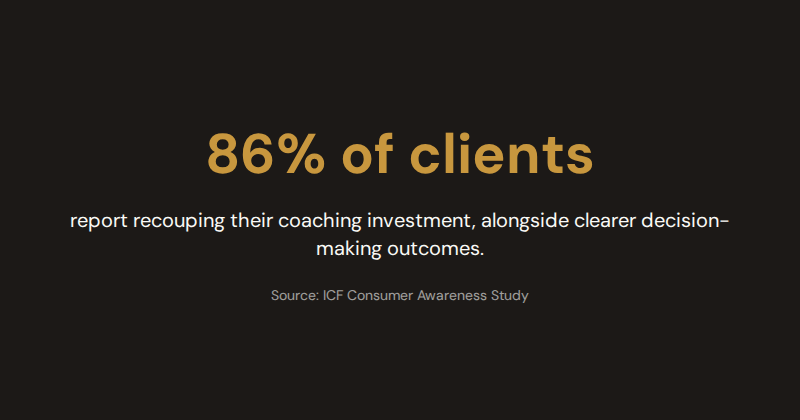
The ICF Consumer Awareness Study found 86% of clients report recouping their coaching investment, and 73% report improved relationships. Those outcomes matter for worry because better clarity and communication reduce uncertainty - one of worry's biggest fuel sources.
When people think more clearly and communicate more directly, they generally make cleaner decisions with less second-guessing.
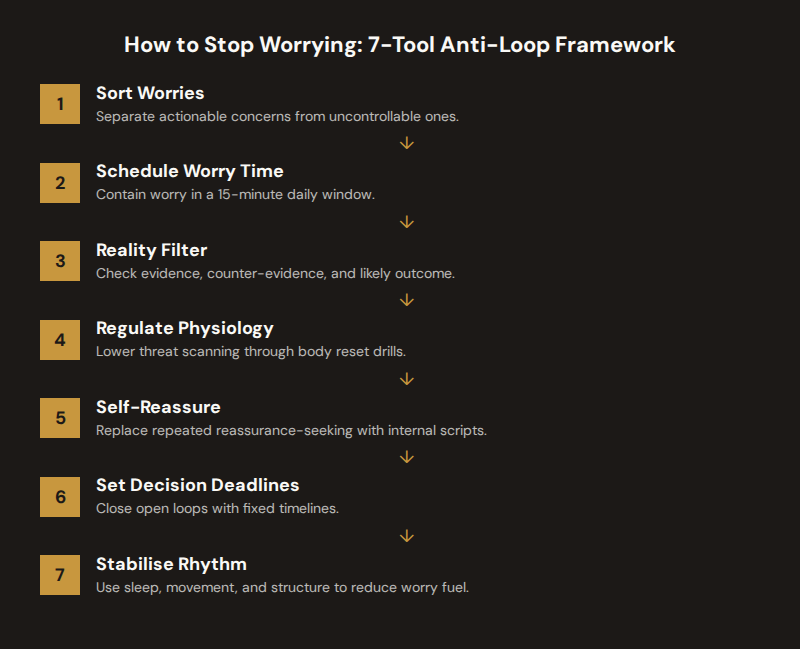
Step 1: Separate "can act" worries from "cannot control" worries
If you want to learn how to stop worrying, this is the first skill.
Draw two columns:
- Can act on now
- Cannot control directly
For each worry, place it in one column.
Then:
- if it is actionable, define one next step
- if it is not controllable, practise release (breathing, acceptance, redirect)
Most people keep trying to solve uncontrollable worries with more thought. That never ends well.
Example
Worry: "What if they think badly of me?"
- actionable: communicate clearly and respectfully
- uncontrollable: their private judgement
Focus your energy where action is possible.
Step 2: Use a daily worry appointment
This is one of the most effective tools for how to stop worrying in everyday life.
Set a 15-minute worry appointment at the same time daily.
Rules:
- outside that window, write worry down and postpone it
- during the window, review and sort each item
- choose action, schedule action, or release action
This teaches your brain that worry has a container. It no longer needs to interrupt every moment.
Step 3: Use the three-question reality filter
Worry often treats possibility as probability.
Use this filter:
- What evidence supports this fear?
- What evidence does not support it?
- What is the most likely realistic outcome?
Then ask one final question:
"What is the next useful action if that outcome happens?"
Now you are preparing, not spiralling.
If overthinking is your main pattern, read how to stop overthinking alongside this.
Step 4: Regulate your body to reduce mental threat scanning
A dysregulated body creates a worried mind.
When sleep is poor, stress is high, and your body is tense, your brain scans for threats faster.
Use this reset 2-3 times daily:
- 60 seconds jaw/shoulder release
- 2 minutes slow exhale breathing
- 60 seconds movement
- one grounding statement: "I am safe enough in this moment"
This does not erase worries instantly. It lowers their intensity enough for better decisions.
For stress-heavy seasons, coaching for stress gives additional practical tools.
Step 5: Replace reassurance-seeking with self-reassurance
Many worriers rely on constant reassurance:
- "Do you think this is okay?"
- "Are you sure I did the right thing?"
- "What if this goes wrong?"
External reassurance helps briefly, then worry returns.
Build internal reassurance instead:
- "I can handle discomfort"
- "I do not need perfect certainty to act"
- "I can adjust if needed"
That shift increases emotional independence.
Step 6: Make decisions with a deadline, not endless deliberation
Worry feeds indecision. Indecision feeds worry.
Break the loop by setting decision deadlines:
- small choices: 5 minutes
- medium choices: 24 hours
- bigger choices: 3-7 days
Use this sentence:
"I have enough information for this decision level. I choose now and refine later."
That one line has saved me hours of unnecessary mental noise.
If worry overlaps with broader anxiety patterns, how to deal with anxiety is a useful companion.
Step 7: Build a life rhythm that gives worry less space
You cannot think your way out of constant worry while living in constant chaos.
Your weekly rhythm should include:
- consistent sleep window
- daily movement
- focused work blocks
- low-stimulation time
- social connection
Structure reduces ambiguity. Less ambiguity means less worry fuel.
For additional support routes, anxiety coaching explains how structured accountability can help.
A 7-day anti-worry implementation plan
If you want how to stop worrying to become real, run this:
Day 1-2
- start two-column worry sort
- begin 15-minute worry appointment
Day 3-4
- apply reality filter to top three recurring worries
- use body reset three times daily
Day 5-6
- set decision deadlines for current open loops
- reduce one reassurance-seeking behaviour
Day 7
- review what helped most
- set your worry plan for next week
Keep it simple and repeatable.
Common mistakes that keep worry alive
-
Treating every thought as urgent
- Not every thought deserves attention.
-
Confusing mental activity with progress
- Worrying can feel productive while achieving nothing.
-
Trying to eliminate uncertainty completely
- Impossible target, endless anxiety.
-
Skipping body regulation
- Physiological tension amplifies mental fear.
-
Waiting for certainty before acting
- Action usually creates clarity, not the other way round.
What progress looks like
Progress is not never worrying again.
Progress is:
- fewer hours lost to loops
- faster recovery after spikes
- cleaner decisions
- less reassurance-seeking
- more trust in your ability to cope
Worry triggers: identify your top three patterns
If you are working on how to stop worrying, generic advice is not enough. You need to know your specific triggers.
Most people have three dominant categories:
- future uncertainty (money, career, health, relationships)
- social judgement (what people think, conflict, rejection)
- loss of control (unexpected changes, delays, ambiguity)
Write your top three recurring worries and classify each one. Once you name your pattern, you can choose the right tool quickly.
Trigger-to-tool map
- future uncertainty -> action plan + decision deadline
- social judgement -> communication script + boundary
- loss of control -> acceptance statement + controllables list
This removes guesswork in the moment.
Practical scripts for high-worry moments
When worry spikes, words matter.
Use these scripts as written:
Script A: before an uncertain conversation
"I do not need perfect wording. I need honesty, clarity, and respect."
Script B: when your mind catastrophises
"This is a possibility, not a certainty. I will respond to facts."
Script C: when you want reassurance repeatedly
"I can tolerate uncertainty and take one useful action now."
Script D: when you are stuck in indecision
"I am setting a decision deadline and choosing the best available option."
These scripts are not magic lines. They are behavioural cues that pull you from fear loops into grounded action.
How to stop worrying at night
Night-time worry deserves its own plan because fatigue amplifies threat perception.
Use this evening shutdown sequence:
- 20-30 minutes before bed, write unresolved tasks
- assign each task a next action and date
- complete three minutes of slow exhale breathing
- no major decision-making in bed
- if worry returns, repeat: "Scheduled for tomorrow, not for now"
If your brain believes issues are captured and scheduled, it stops pushing so hard at midnight.
How to stop worrying at work without shutting down ambition
Worry at work usually appears as:
- over-checking messages
- delayed decisions
- perfection loops
- inability to switch off
Use this work structure:
- 10-minute daily priority clarity
- one deep work block before reactive tasks
- one deliberate decision window for open loops
- end-of-day closure list (done, pending, next)
Ambition works better with structure than with constant mental pressure.
The 14-day worry reset
To make how to stop worrying practical, run this reset:
Days 1-3
- classify top three worry patterns
- start daily worry appointment
- practise body reset twice daily
Days 4-7
- apply reality filter to recurrent worries
- set decision deadlines for current open loops
- reduce one reassurance-seeking habit
Days 8-11
- improve evening shutdown routine
- use trigger-to-tool map in real time
- track worry intensity morning/evening (1-10)
Days 12-14
- review what reduced intensity fastest
- keep top three tools as your standard routine
- plan next two weeks with same system
This is where change becomes visible: not because worry disappears, but because you stop obeying it.
That shift is powerful. You start living from intention instead of alarm. You make clearer choices, recover faster after hard days, and spend more of your life in the present rather than in imagined futures. That is what practical progress looks like.
Steady beats dramatic. Repeated tools beat rare breakthroughs.
Small daily wins compound quickly.
That is realistic, measurable, and life-changing.
Frequently asked questions
What is the difference between worry and problem-solving?
Problem-solving produces a clear next action. Worry repeats fear without movement.
Why do I worry even when things are okay?
Because worry can become a learned safety behaviour. Your brain keeps scanning for danger out of habit.
Can I stop worrying without ignoring real issues?
Yes. You are not ignoring problems; you are approaching them with structure instead of rumination.
How fast can worry tools work?
Most people feel some relief within days if they apply the tools consistently, especially worry scheduling and decision deadlines.
When should I get extra support?
If worry regularly affects sleep, concentration, work, or relationships, structured support can help you regain control faster.
Working with a coach
If worry has become your default mode and you want practical structure to break the pattern, coaching can help you build calmer routines and clearer decision habits. If you want support, you can book an initial session.