By Alistair Johnstone
If you are searching how to deal with anxiety, you probably do not need another article telling you to "just relax".
You need strategies that work when your chest is tight, your mind is racing, and life still expects you to function.
Anxiety was my constant companion in early sobriety. My nervous system was raw, and my head treated every uncertainty like an emergency. I was outwardly "fine" and internally exhausted.
What changed things was not pretending anxiety did not exist. It was learning how to work with it in real time.
This is a practical guide for exactly that.
Key takeaways
- Anxiety responds better to structure than to motivation
- Regulating your body first makes cognitive tools more effective
- Small daily systems reduce anxiety spikes over time
- Avoidance feeds anxiety; measured action shrinks it
- You can build calm without waiting for perfect circumstances
Why anxiety feels like a personal failure (and why it is not)
Anxiety often feels private, but the data shows it is widespread.
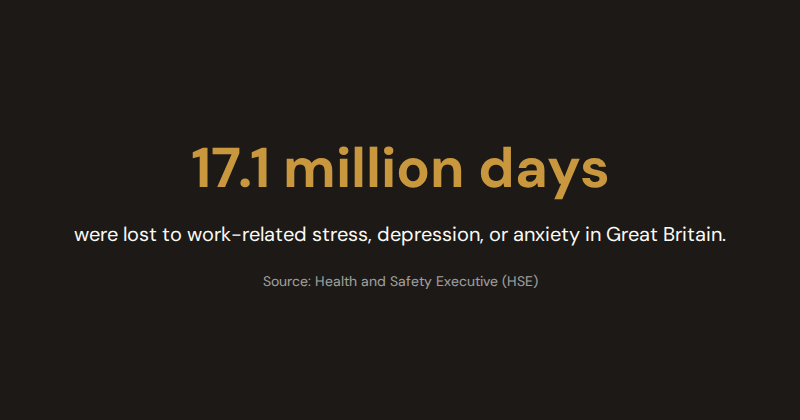
The Health and Safety Executive reports 17.1 million working days lost to work-related stress, depression, or anxiety in Great Britain in a recent year. That is not a niche problem.
And the workplace impact is costly too: Deloitte UK estimates poor mental health costs UK employers around £51 billion per year when absenteeism, presenteeism, and staff turnover are included.
So if anxiety is affecting your focus or energy, you are not weak. You are human in a high-pressure environment.
The goal is not "never feel anxious again". The goal is to stop anxiety running your decisions.
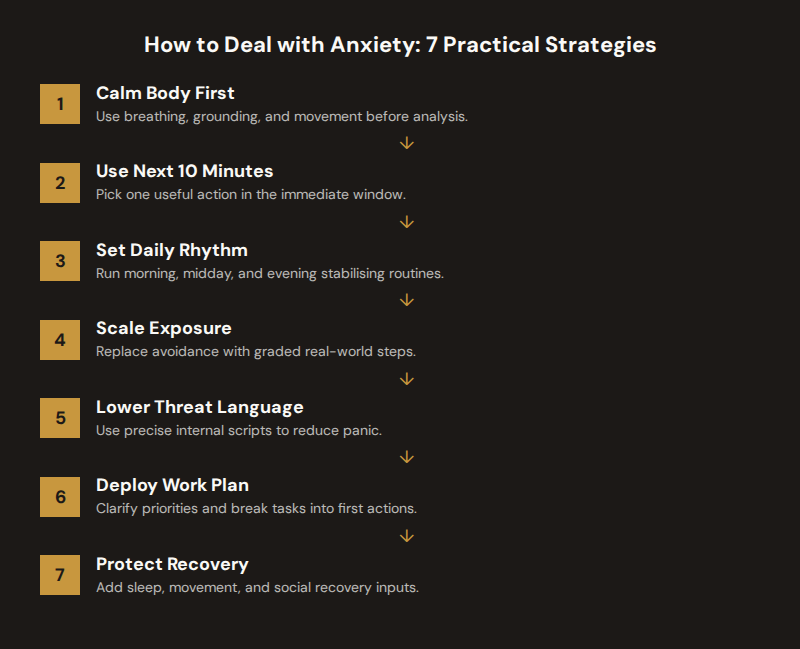
Strategy 1: Calm your body before negotiating with your thoughts
If you want to know how to deal with anxiety, start here.
When your nervous system is activated, logic alone rarely works. You can argue with your thoughts for an hour and still feel on edge.
Use this 5-minute reset instead:
- Breathe longer out than in for two minutes (e.g. in 4, out 6)
- Name five things you can see to anchor in the present
- Press your feet into the floor and release shoulder tension
- Move your body for 60-90 seconds (walk, stretch, shake arms)
This is not about denying emotion. It is about bringing your physiology down so your brain can think clearly again.
Strategy 2: Use the "next ten minutes" method
Anxiety pulls your mind into catastrophic future scenarios.
Counter it with a narrow time frame:
Ask: "What is the most useful action in the next ten minutes?"
Examples:
- send the one email
- drink water and step outside
- open the document and write one paragraph
- message someone and ask for clarity
Ten minutes sounds small, but it breaks paralysis.
When I was rebuilding routine in sobriety, this method kept me moving. I stopped trying to solve my whole life in one thought spiral and started completing the next concrete action.
Strategy 3: Build a low-anxiety daily rhythm
You cannot control every trigger, but you can lower your baseline.
For people searching how to deal with anxiety, this is where long-term change happens.
Baseline plan
Morning (10-15 minutes)
- no phone for first five minutes
- one grounding routine (breathing, short walk, journalling)
- choose top three priorities
Midday (5 minutes)
- body reset
- check tension: jaw, shoulders, breathing
Evening (10 minutes)
- brain dump unfinished tasks
- write tomorrow's first action
- reduce late-night stimulation
This rhythm reduces uncertainty and mental clutter, both of which amplify anxiety.
If your anxiety is strongly linked with overanalysis, pair this with how to stop overthinking.
Strategy 4: Replace avoidance with graded exposure
Avoidance gives short-term relief and long-term anxiety growth.
If an action feels overwhelming, scale it down rather than skip it.
Graded exposure ladder
Example: difficult work conversation
- write the key points
- rehearse for two minutes
- send a short message to book time
- have the conversation with one clear objective
Each successful step teaches your brain: "I can handle this."
The same principle applies socially, professionally, and personally.
Strategy 5: Use language that lowers threat
Your internal language can either inflame anxiety or contain it.
Swap these:
- "I can't cope" -> "This is hard, but I can take one step"
- "Everything is going wrong" -> "Some things are hard; what is in my control now?"
- "I need certainty" -> "I need a workable next action"
This is not fake positivity. It is cognitive precision.
Strategy 6: Create an anxiety plan for work
Work is a major anxiety trigger for many people, so build a specific system.
Work anxiety plan
- Start with clarity: confirm priorities with your manager/team early
- Chunk tasks: first draft, first send, first review
- Use timed focus blocks: 25-40 minutes, then short reset
- Close loops daily: list what is done, pending, and next
This reduces hidden ambiguity, which is often the fuel behind workplace anxiety.
For more on support options, coaching vs therapy can help you decide what fit is best.
Strategy 7: Build recovery, not just performance
Anxiety rises when your life becomes output-only.
You need recovery inputs:
- movement
- daylight
- social contact
- sleep protection
- quiet without screens
These are not luxuries. They are regulation tools.
If stress is your main pressure point, this companion read may help: coaching for stress.
A seven-day implementation plan
To make how to deal with anxiety practical, run this for one week:
Day 1-2
- practise the 5-minute reset twice daily
- identify top three personal anxiety triggers
Day 3-4
- apply "next ten minutes" to one avoided task each day
- reduce one avoidance behaviour
Day 5-6
- build your work anxiety plan and test it
- add one recovery input (walk, call, early night)
Day 7
- review wins, friction points, and what you will keep
Small consistent reps beat occasional big efforts.
Common mistakes that keep anxiety stuck
-
Treating anxiety as an identity
- "I'm an anxious person" keeps you passive.
-
Only using tools in crisis
- Practise when calm so they work when stressed.
-
Trying to remove all discomfort
- Growth needs manageable discomfort.
-
Ignoring your body
- Physiology drives thought quality more than people realise.
-
Confusing planning with control
- Excess planning can become hidden avoidance.
Real-life anxiety scenarios and what to do in the moment
One reason people feel discouraged is that anxiety hits in specific moments, not in perfect textbook settings. So here are practical scripts for common situations.
Scenario 1: You wake up anxious before work
What usually happens:
- instant phone check
- cortisol spike
- racing thoughts before you even stand up
Try this instead:
- keep your phone away from the bed
- sit up and do 10 slow breaths
- write three lines: "today's priority", "today's stressor", "today's first step"
- start with one simple action before email
This prevents your morning from becoming reactive from minute one.
Scenario 2: You get a short message and assume the worst
This one catches a lot of people. A short "Can we talk?" message can trigger ten imagined disasters.
Use the reality filter:
- fact: "I received a short message"
- story: "I am in trouble"
- response: "I will ask for context directly"
Then send: "Yes, happy to talk. Is there anything specific you'd like me to prepare?"
Direct communication beats mental guessing every time.
Scenario 3: You feel anxious in social situations
When social anxiety rises, your attention turns inward and self-critical.
Use outward focus prompts:
- "What is one good question I can ask?"
- "Who here might appreciate a genuine hello?"
- "What can I contribute in one sentence?"
Connection improves when you move from self-monitoring to presence.
Scenario 4: You are anxious at night and cannot switch off
Night anxiety often combines fatigue with unresolved loops.
Use a close-down routine:
- write unfinished tasks for tomorrow
- decide first action for each
- do three minutes of slower exhale breathing
- avoid "problem-solving" in bed
Your bed should be for rest, not strategic crisis planning.
A practical anxiety toolbox you can save
If you came here for how to deal with anxiety, save this as your quick reference:
For sudden spikes
- longer exhale breathing
- cold water on wrists/face
- 60-90 seconds movement
- grounding by naming five visible objects
For recurring worry
- worry appointment
- fact/story/action sorting
- written action list for controllables
For work pressure
- clarify top priorities early
- break tasks into first actions
- use timed focus blocks
- close open loops at end of day
For long-term resilience
- consistent sleep window
- regular movement
- honest social contact
- weekly review of triggers and progress
The goal is not to become a perfectly calm person. The goal is to have reliable tools so anxiety does not run your life.
What progress actually looks like
Progress is not "I never feel anxious".
Progress is:
- quicker recovery after spikes
- fewer hours lost to spirals
- better decisions under pressure
- less avoidance
- more trust in your own capacity
That is realistic, measurable, and absolutely possible.
If you want to keep reading, anxiety coaching breaks down how support can help when anxiety has become your default pattern.
Frequently asked questions
What is the best immediate strategy for anxiety?
Regulate your body first: breathing, grounding, and movement. Once your nervous system settles, your thinking improves.
Can routines really reduce anxiety?
Yes. Predictable routines reduce uncertainty and mental load, which reduces baseline anxiety over time.
How do I deal with anxiety at work?
Clarify priorities early, break tasks into small actions, use timed focus blocks, and close open loops daily.
How is anxiety different from stress?
Stress usually has a clear external cause. Anxiety can persist even without a current threat and often includes future-oriented worry.
When should I seek structured support?
If anxiety is consistently affecting your sleep, work, relationships, or confidence, structured support can help you move forward faster.
Working with a coach
If anxiety is repeatedly getting in the way of your work, routines, or relationships, coaching can help you build practical systems and accountability around the tools above. If you want support, you can book an initial session.