By Alistair Johnstone
If you searched how to improve self esteem, there is a good chance you are tired of being told to "just love yourself".
Low self-esteem is rarely fixed by one inspirational sentence. It is usually rebuilt through behaviour, standards, and evidence over time.
My self-esteem was rebuilt in the gym, one 3:45am alarm at a time. Not because lifting weights is magic, but because keeping difficult promises to myself changed how I saw myself. I stopped waiting to feel confident and started acting like someone I could trust.
This guide shows you how to do that in a practical way.
Key takeaways
- Self-esteem is built through action, not performance
- Consistent movement can improve body confidence and emotional resilience
- Boundaries and self-talk shape self-worth more than people realise
- You do not need to feel confident to start; starting creates confidence
- A simple repeatable framework beats perfection every time
Why self-esteem drops (even in capable people)
Low self-esteem does not only affect people who are "failing".
I have seen high-performing people with careers, families, and responsibilities who still feel not enough. Why? Because self-esteem is about internal relationship, not public image.
Common causes include:
- repeated criticism or comparison
- people-pleasing as a survival pattern
- perfectionism and fear of mistakes
- unresolved shame from past decisions
- neglecting your own standards for too long
The good news: self-esteem is trainable.
What the data says about movement and confidence
The relationship between physical activity and self-perception is strong.
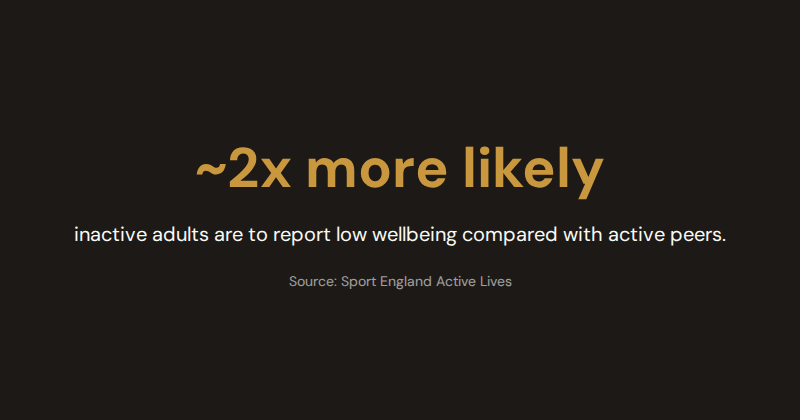
Sport England's Active Lives data and wellbeing reporting consistently shows that active adults are significantly more likely to report high happiness and lower anxiety than inactive adults. In many reporting cycles, people who are inactive are roughly twice as likely to report low wellbeing compared with active peers.
Sport England also links regular activity with stronger confidence and body positivity outcomes, especially when people move consistently rather than pursuing extreme short-term targets.
That does not mean you need a perfect body. It means your body can become a place where trust is rebuilt.
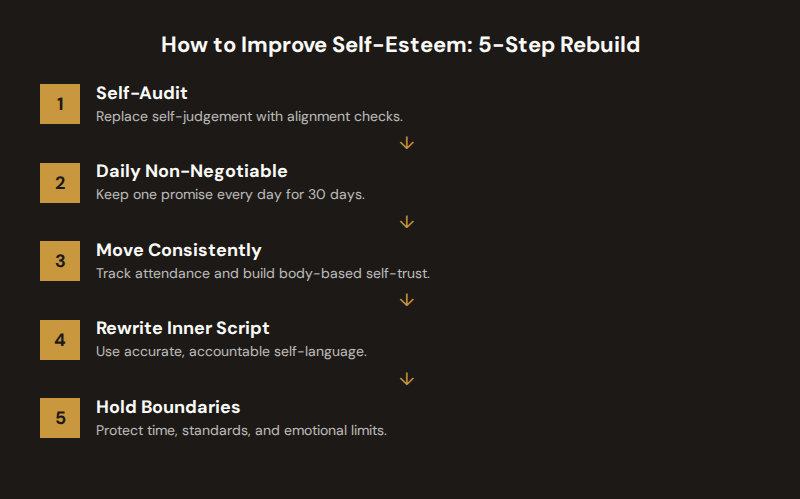
Step 1: Replace self-judgement with self-audit
If you want to learn how to improve self esteem, begin by changing the question.
Most people ask: "What's wrong with me?"
Ask this instead:
- What standards do I say I have?
- Where am I currently out of alignment?
- What one behaviour would move me back into integrity this week?
Self-judgement creates paralysis. Self-audit creates movement.
Quick self-audit template
- Health: one behaviour to upgrade
- Work: one commitment to complete
- Relationships: one honest conversation to have
- Boundaries: one place to say no
You are not fixing your whole personality. You are rebuilding alignment.
Step 2: Keep one non-negotiable promise daily
Confidence is memory-based.
Every time you keep a promise, self-trust rises. Every time you repeatedly break promises, self-trust drops.
Pick one daily non-negotiable for the next 30 days:
- 20 minutes of movement
- no phone in bed
- complete the hardest task first
- journal for 10 minutes
- stop saying yes when you mean no
Start small enough that you can actually win.
I learned this the hard way. In early rebuild seasons, grand plans failed me. Simple, repeated commitments changed me.
Step 3: Build body confidence through consistent movement
When people ask how to improve self esteem, they often avoid the body piece because it feels sensitive.
But movement is not about aesthetics alone. It is identity work.
Practical movement framework
- choose a realistic weekly minimum (e.g. 3 sessions)
- track attendance, not perfection
- celebrate consistency, not intensity
What this builds:
- discipline under discomfort
- evidence of follow-through
- a more respectful relationship with your body
If confidence in your body has been damaged by relationship history, rebuild after toxic relationship may also help.
Step 4: Change the inner script you repeat all day
Low self-esteem is often reinforced by automatic language:
- "I'm useless"
- "I always mess things up"
- "No one respects me"
You do not need fake affirmations. You need accurate language.
Try this swap:
- "I'm behind" -> "I'm rebuilding"
- "I'm weak" -> "I'm practising consistency"
- "I'm a failure" -> "I made mistakes and I am correcting course"
Language shapes identity. Identity shapes behaviour.
When I shifted from self-punishment to accountability, change accelerated.
Step 5: Set boundaries that prove your worth to yourself
Many people with low self-esteem are excellent at abandoning themselves.
Boundary work is self-esteem work.
Start with one boundary in each area:
- time: protect one focused hour daily
- relationships: stop overexplaining your no
- work: stop agreeing to unrealistic commitments
- self-talk: interrupt insults you would never say to someone you love
Every boundary you hold sends this message internally: "My needs and values matter."
That is the heart of self-worth.
For a deeper confidence lens, confidence coaching expands on performance and identity.
A 30-day self-esteem rebuild plan
If you want how to improve self esteem to become practical, run this:
Week 1: Awareness
- complete self-audit
- identify top three self-critical scripts
- pick your daily non-negotiable
Week 2: Consistency
- keep the non-negotiable daily
- add three movement sessions
- write one daily "proof of progress" line
Week 3: Boundaries
- set one boundary at work
- set one boundary in a personal relationship
- stop one people-pleasing behaviour
Week 4: Identity integration
- review evidence of promises kept
- define your updated personal standards
- choose next month's non-negotiable
This is how confidence is built in real life: behaviour first, self-image second.
Mistakes that keep self-esteem low
-
Waiting to feel confident before acting
- Action usually comes first.
-
Comparing your process to someone else's highlight reel
- Comparison destroys focus.
-
Treating one bad day as proof of failure
- One miss is feedback, not identity.
-
Using criticism as truth instead of data
- Not every opinion deserves authority.
-
Avoiding difficult conversations
- Avoidance erodes self-respect over time.
What healthy self-esteem looks like
Healthy self-esteem is not arrogance.
It looks like:
- speaking to yourself with firmness and respect
- recovering faster after setbacks
- taking responsibility without self-destruction
- setting standards and keeping them
- being kind without becoming a doormat
That is available to you, even if it feels far away today.
If self-esteem has been the central issue for a while, coaching for self-esteem gives a clear view of what structured support can look like.
You may also find how to be happy useful if your confidence and mood are both taking a hit.
Real-world self-esteem rebuild examples
People often ask for "real life" versions of these tools, so here are three common situations.
Example 1: Work confidence is low after a setback
Pattern:
- one mistake happens
- identity collapses to "I'm not good enough"
- procrastination increases
- confidence drops further
Practical response:
- write a factual debrief (what happened, what did not happen)
- identify one correction action within 24 hours
- complete one visible win the same day
- ask for feedback on behaviour, not your identity
This returns you to evidence-based confidence instead of emotional storytelling.
Example 2: Relationship dynamics damaged self-worth
Pattern:
- constant criticism or mixed signals
- over-explaining and people-pleasing
- boundaries disappear
Practical response:
- identify your non-negotiables in writing
- set one boundary with a clear sentence
- stop negotiating your basic needs
- track how you feel after boundary-honouring decisions
Confidence grows when your behaviour communicates self-respect.
Example 3: Body image is driving low self-esteem
Pattern:
- all-or-nothing fitness plans
- missed days become self-attack
- shame blocks consistency
Practical response:
- commit to a sustainable weekly minimum
- track attendance, not perfection
- measure mood and energy improvements, not just appearance
- celebrate consistency milestones every two weeks
This is exactly where movement supports self-esteem: it gives repeated proof that you can show up for yourself.
A weekly self-esteem review that actually works
If you are serious about how to improve self esteem, use this review every Sunday:
1) Evidence review
- What promises did I keep this week?
- Where did I show courage or integrity?
- What did I avoid, and why?
2) Language review
- Which self-critical script showed up most?
- What is the more accurate replacement script?
3) Boundary review
- Where did I abandon myself?
- Where did I honour myself?
4) Action plan
- one non-negotiable for next week
- one boundary to hold
- one hard conversation to have
Do this for four weeks and compare how you feel, decide, and communicate.
What self-esteem rebuilding is not
To avoid confusion, here is what this process is not:
- not pretending you are amazing every day
- not becoming self-centred
- not waiting until you feel healed before acting
- not demanding perfection from yourself
Healthy self-esteem is grounded, not performative.
It sounds like:
- "I can be imperfect and still respect myself"
- "I can be criticised without collapsing"
- "I can hold standards without hating myself"
If that feels unfamiliar, it is okay. It becomes more natural through repetition.
And if you are still working out how to improve self esteem in high-pressure seasons, keep your process practical: fewer promises, better follow-through, honest weekly review.
Done consistently, that approach changes not only how you feel, but how you behave in every room you walk into.
Frequently asked questions
What is the fastest way to improve self-esteem?
Keep one small promise to yourself every day. Confidence grows from repeated evidence.
Can exercise really help self-esteem?
Yes. Consistent movement improves mood, body confidence, and self-perception, especially when the goal is consistency rather than perfection.
Why does criticism affect me so much?
If self-worth depends on external approval, criticism feels like a personal threat. Internal standards reduce that volatility.
How long does rebuilding self-esteem take?
Most people notice improvements in weeks, with deeper changes developing over months of consistent action.
What if my confidence issues come from a past relationship?
That is common. Boundaries, self-trust routines, and structured support can help you separate your worth from old dynamics.
Working with a coach
If you want help turning these steps into a consistent plan, coaching can provide structure, accountability, and practical feedback while you rebuild self-worth. If you want support, you can book an initial session.