By Alistair Johnstone
If you searched how to build confidence, you probably do not need another motivational quote. You need a method that works when your head is noisy and your inner critic is loud.
I know that feeling well. Earlier in my life, I looked functional on the outside and felt like I was winging it underneath. I thought confidence was something other people were born with. Then I learned the hard way that confidence is built in public, in small moments, by keeping promises you make when nobody is watching.
Confidence is not a personality type. It is a system.
Key Takeaways
- If you are searching how to build confidence, start with behaviour, not feelings
- Confidence grows when you keep tiny daily promises to yourself
- Evidence beats affirmations: track what you do, not what you wish you felt
- Fear does not vanish first; action comes first, then confidence follows
- A repeatable weekly review protects confidence from setbacks
Why Most Confidence Advice Fails
Most advice about how to build confidence assumes that if you feel better, you will act better. In real life, it usually works the other way round.
You act first. Then your nervous system updates its view of what you are capable of.
That is exactly what I tell clients who say, “I will do it when I feel ready.” Readiness is not a feeling that arrives by post. Readiness is built through repetitions.
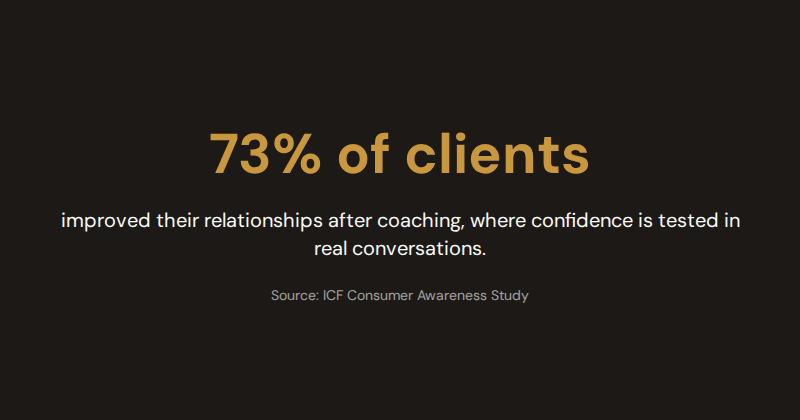
The evidence around coaching outcomes points in the same direction. The ICF Consumer Awareness Study reports that 73% of coaching clients improved their relationships, which is often where confidence is tested most: difficult conversations, boundaries, and clear communication. Confidence is social behaviour in motion, not private optimism.
At work, pressure makes this harder. The HSE reports that stress, depression, and anxiety account for around half of all work-related ill health cases in Great Britain. Under strain, self-doubt spikes, and people default to avoidance.
And from a wellbeing point of view, structure matters. Sport England Active Lives shows that 22.4% of adults are inactive (doing less than 30 minutes of activity per week). Inactivity is not just physical; it is psychological drift. Confidence and momentum are closely linked.
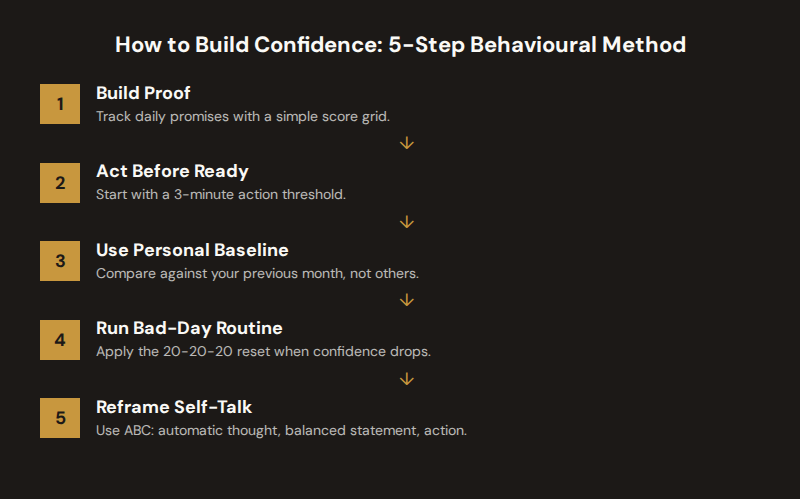
Step 1: Build Proof, Not Hype
If you want a practical answer to how to build confidence, start here: collect proof that you can trust yourself.
The 7-Day Promise Grid
For one week, set three tiny non-negotiables each day:
- One body action (for example: 20-minute walk)
- One work action (for example: send the difficult email)
- One integrity action (for example: say no where you usually people-please)
Keep each action small enough that you cannot hide behind complexity.
Then score yourself each evening:
- 1 = done
- 0 = not done
No essays. No guilt. Just data.
Why this works: your brain trusts repeated evidence. Every completed action is a vote for a new identity: “I follow through.”
When I rebuilt my own confidence, this was the turning point. Not one breakthrough day. Hundreds of unglamorous reps.
Step 2: Use the "Act Before You Feel Ready" Rule
Most people who search how to build confidence are waiting for a state change. But waiting is often disguised fear.
Use this rule instead:
Do the first 3 minutes now.
Not the whole task. Just the first move:
- Open the document
- Put trainers on
- Make the call
- Walk into the room
Three minutes cuts through overthinking and gets you across the threshold where confidence starts to form.
I often say this in sessions because it is true in lived practice: confidence is not something you feel first and then act on. You act first, and the confidence follows.
The 3-2-1 Exposure Ladder
Pick one confidence challenge (speaking up, social anxiety, setting boundaries). Build a ladder:
- Level 1 (easy): low-stakes action
- Level 2 (moderate): mildly uncomfortable action
- Level 3 (hard): high-stakes action
Repeat Level 1 until it feels routine, then move up. Exposure with repetition rewires fear faster than theory.
Step 3: Stop Letting Comparison Steal Your Momentum
Comparison is one of the biggest killers of confidence. It makes progress feel invisible.
If you keep comparing your behind-the-scenes to someone else’s highlight reel, you will always feel late.
The Personal Baseline Method
Instead of asking, “Am I as good as them?” ask:
- What was true for me 30 days ago?
- What is true now?
- What did I do that created the shift?
Document this weekly in a notes app or notebook. Keep it factual:
- “Spoke up once in the meeting”
- “Asked for clearer boundaries”
- “Submitted the proposal without over-editing”
That is confidence data.
If social media amplifies your self-doubt, set a hard boundary: no scrolling before your first meaningful action of the day. Protect your focus before exposure to noise.
Step 4: Build a Confidence Routine for Bad Days
Anyone can feel confident on a good day. The real skill is maintaining direction on bad ones.
When I was getting sober, people celebrated the decision. They did not see the empty hours that followed. Those were the moments where structure saved me: simple routines, repeated daily, whether I felt like it or not.
That lesson applies directly to confidence.
The 20-20-20 Reset
Use this when confidence crashes:
- 20 minutes move — walk, cycle, or any brisk movement
- 20 minutes focus — one task that matters
- 20 minutes admin reset — clear one source of background stress
In one hour, you restore agency. Not perfectly, but enough to stop spiralling.
This is crucial if you are trying to learn how to build confidence in demanding seasons of life. Confidence often returns through regulation before reflection.
Step 5: Audit Your Self-Talk Like a Professional
Self-talk is not fluffy. It is performance language.
Untrained self-talk sounds like:
- “I always mess this up.”
- “Everyone can see I am faking it.”
- “I am just not that kind of person.”
Trained self-talk sounds like:
- “I am learning this under pressure.”
- “I can be nervous and still do this well.”
- “One action now is better than ten plans later.”
The ABC Reframe
Use this in writing:
- A: Automatic thought (what your mind says)
- B: Balanced statement (a grounded replacement)
- C: Chosen action (what you will do next)
Example:
- A: “I am going to embarrass myself.”
- B: “I might feel awkward, and I can still communicate clearly.”
- C: “Speak once in the first ten minutes.”
This turns abstract confidence work into a repeatable process.
A 30-Day Confidence Plan You Can Actually Use
If you are serious about how to build confidence, use this simple structure:
Week 1: Stabilise
- Start the 7-day promise grid
- Remove one confidence-draining habit (doom scroll, avoidance email loop)
- Complete one Level 1 exposure each day
Week 2: Expand
- Keep daily promises
- Add one difficult conversation
- Move from Level 1 to Level 2 exposures
Week 3: Consolidate
- Review your baseline notes
- Repeat what is working
- Add one boundary you have been postponing
Week 4: Stretch
- Attempt one Level 3 exposure
- Track outcomes, not feelings alone
- Write your personal confidence playbook for next month
You do not need perfect execution. You need continuity.
Common Mistakes That Keep You Stuck
- Waiting to feel confident before acting
- Setting goals too big to sustain daily
- Treating setbacks as identity, not feedback
- Confusing performative confidence with grounded confidence
- Trying to do everything alone while hiding struggles
If one of these lands hard, good. Awareness is progress.
Internal Confidence vs External Confidence
People often chase external confidence first: posture, voice, social fluency. Those matter, but they are downstream.
Internal confidence is the base layer:
- Self-trust
- Boundary clarity
- Emotional regulation
- Follow-through
When internal confidence improves, external confidence becomes sustainable.
If your confidence struggles are closely tied to self-worth, read coaching for self-esteem and how to improve self-esteem next. If you are deciding whether practical support would help, confidence coaching explains the structure.
For momentum, this guide on how to find motivation pairs well with confidence work because action consistency sits at the centre of both.
Final Checklist: How to Build Confidence This Week
Before you close this page, choose:
- One daily body action
- One daily work action
- One daily integrity action
- One exposure challenge
- One weekly review slot
That is enough to begin.
If you came here searching how to build confidence, do not leave with only ideas. Leave with your first seven days planned.
Confidence in Conversations: A Practical Script Library
Many people feel reasonably confident alone and lose it in conversation. That is normal. Confidence is often tested most in moments where there is uncertainty, disagreement, or potential rejection.
Use these scripts until they feel natural.
When you need to speak up in a meeting
"I want to add a point here before we move on."
Short. Clear. No apology.
When you need to set a boundary
"I can do that by Friday, or I can include the extra section by Monday. Which do you want prioritised?"
This keeps you collaborative without abandoning your limits.
When you disagree respectfully
"I see it differently. Can I share another option?"
Confidence is not dominance. It is clarity with composure.
When imposter thoughts spike
"I may not have every answer yet, and I can contribute usefully right now."
The goal is not to erase nerves. The goal is to continue with integrity while nerves are present.
A 90-Day Confidence Tracker
If you want this change to stick, track three categories for 90 days:
- Courage actions — where you acted despite discomfort
- Integrity actions — where you kept promises to yourself
- Boundary actions — where you protected time/energy respectfully
At the end of each week, write:
- one win you are proud of
- one lesson from a miss
- one adjustment for next week
By month three, you will have hard evidence of growth. Evidence changes identity faster than intention.
One more practical point: if your confidence drops sharply after setbacks, treat setbacks as data events, not verdicts. Ask, "What did this teach me about preparation, pace, or communication?" That question keeps momentum alive.
Confidence is not fragile when it is process-based. It becomes much harder to knock over because it is no longer dependent on a perfect day.
Frequently Asked Questions
How long does it take to build confidence?
Most people notice a shift within two to four weeks when they use daily actions and honest review. Deep confidence is built over months, not days.
Can confidence improve even if I still feel anxious?
Yes. Confidence and anxiety can exist at the same time. Confidence grows when you keep acting in line with your values despite nerves.
What is the fastest way to stop feeling like a fraud?
The fastest way is evidence: write down wins, keep promises to yourself, and do one uncomfortable action every day. Fraud feelings shrink when proof grows.
Does confidence come from positive thinking?
Positive thinking helps, but confidence is mostly behavioural. You build it by doing difficult things consistently and reviewing the results honestly.
What if I keep comparing myself to everyone else?
Use a comparison boundary: compare yourself only to your own previous week. That keeps your focus on progress you can control.
Working with a coach
If you want personalised support applying this in real life, you can get in touch here. We can look at your patterns, pressure points, and what confidence-building structure would actually fit your week.